

Most employees do not need a complicated recognition platform to feel valued. They need someone to notice what they did, say it clearly, and make the thanks feel real.
That is especially true for small UK employers. In a smaller business, school, charity, club or local team, recognition does not have to become a major HR project. It can be simple, regular and personal.
The useful version is this:
Say what someone did, why it mattered, and make the thank-you feel considered.
Recognition works best when it is specific, fair and easy to repeat. The point is not to create another process for managers to forget. The point is to build small moments of appreciation into normal working life.
Note for UK employers: this article is general guidance, not tax or legal advice. HMRC rules apply UK-wide, while employment guidance and dispute processes can vary across the UK. Check HMRC, Acas or your professional adviser where needed.
The quick answer: five simple ways to recognise staff
To recognise staff without overcomplicating it:
- Say thank you quickly and specifically.
- Mention the impact of the work.
- Recognise quiet, behind-the-scenes contributions.
- Ask how people prefer to be recognised.
- Keep recognition fair, consistent and easy to repeat.
Gallup says the most effective recognition is honest, authentic and individualised to how each employee wants to be recognised. It also notes that recognition can be low-cost, including something as simple as a personal note or thank-you card.
Staff recognition does not need to be a big scheme
Recognition does not have to mean points, dashboards, leaderboards or a monthly ceremony. Those things can work in some organisations, but they are not the starting point for most small employers.
The starting point is ordinary management done well.
A manager notices the receptionist calmly handling a difficult visitor. A team leader thanks someone for covering a shift at short notice. A business owner mentions the person who fixed a small problem before it became expensive. A colleague says, “That made today easier.”
CIPD’s evidence review says employers should not overlook incentives or recognition when trying to motivate staff and boost performance, and recommends encouraging managers and colleagues across the organisation to share recognition.
That is the spirit of simple recognition. It does not need to be grand. It needs to be noticed.
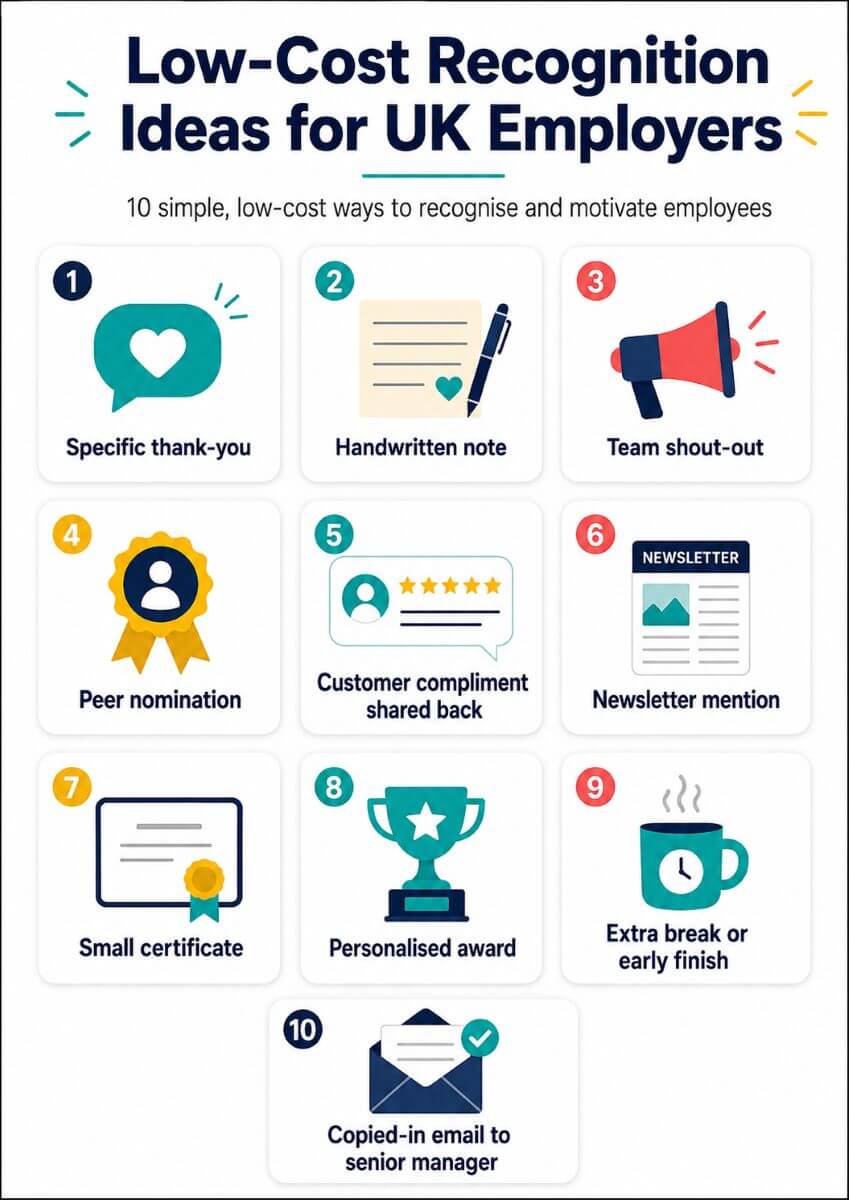
ideas for UK employers, including thank-you notes and team shout-outs. Small recognition gestures can be powerful when they are specific, sincere and easy for managers to repeat
A compact list of low-effort recognition ideas
| Recognition idea | Why it works |
| Specific thank-you | Quick, free and personal |
| Handwritten note | Feels considered and lasting |
| Team meeting shout-out | Public without being over-formal |
| Email copied to a senior manager | Shows the work was noticed beyond the immediate team |
| Peer nomination | Lets colleagues recognise each other |
| Customer compliment shared back | Connects the person to real-world impact |
| Small certificate or desk card | Gives the person something to keep |
| Extra break or early finish | Practical, where fair and operationally possible |
| Newsletter mention | Extends the recognition beyond the room |
| Small personalised award | Useful for milestones, team events or formal moments |
The best option depends on the person, the work and the setting. Some employees like public recognition. Others prefer a quiet message.
Say exactly what you are recognising
The easiest way to improve staff recognition is to make it more specific.
Weak recognition sounds like this:
“Great work.”
Better recognition sounds like this:
“Thank you for staying calm with that customer complaint and getting it resolved before it reached the wider team.”
Use this formula:
Name + action + impact
Examples:
| Situation | Better recognition wording |
| Customer service | “Thanks for handling that difficult call calmly and keeping the customer with us.” |
| Admin | “You spotted the invoice issue before it became a bigger problem.” |
| Operations | “You kept the shift moving when two people were off sick.” |
| Management | “You gave the team clarity when the deadline changed.” |
| New starter | “You asked good questions and helped us improve the process.” |
| Quiet contributor | “The work you did in the background made today much easier for everyone.” |
The phrase “well done” is not wrong. It is just unfinished. Add the action and the impact, and the employee knows you really saw what happened.
Ask people how they like to be recognised
Recognition feels better when it suits the person receiving it.
Gallup’s point about individualised recognition is important because not everyone experiences praise in the same way. Some people enjoy a public shout-out. Others would rather receive a quiet thank-you, a handwritten note or a private message.
Small employers can ask simple questions:
- “Do you prefer public or private recognition?”
- “Would you be comfortable being mentioned in a team meeting?”
- “Are you happy for us to share this in the newsletter?”
- “Would you like your name included in a public post?”
- “Is there anything you would rather we did not do?”
This is especially useful before public awards, photos, newsletters or social posts. Recognition should make the person feel valued, not exposed.
Build recognition into normal management
Recognition should not only happen at Christmas, during appraisals, at annual awards or when someone is leaving.
It can happen in:
- One-to-ones
- Team meetings
- Shift handovers
- End-of-week roundups
- Project debriefs
- Internal newsletters
- Manager notes
- Peer nominations
Acas says performance reviews are a chance to discuss someone’s work, including what they are doing well, areas for improvement, whether they need more support or training, and development objectives.
That is a useful reminder: recognition belongs inside ordinary performance conversations, not only at special events.
A simple line in a one-to-one can be enough:
“Before we talk about next week, I want to say the way you handled that handover made a real difference.”
That takes ten seconds. It can stay with someone for much longer.
Make recognition timely
Recognition works best when it happens close to the moment you are recognising. If someone handles a difficult customer, covers a shift, solves a problem or helps a colleague, the thank-you should not wait until the next appraisal or annual awards night. A quick, specific message on the same day often feels more genuine than a formal mention months later. Timely recognition shows that the work was noticed in context, while the effort, pressure and impact are still fresh. Some companies like Impact sell medals, trophies, and awards with next day delivery, so there is really no excuse to not
Keep recognition small enough to repeat
If recognition becomes too elaborate, managers stop doing it.
Small recognition works because it can happen often. It does not require a budget meeting, a nomination panel or a full presentation plan.
A handwritten note, a quick message, a team-meeting mention or a copied-in email can all work when the wording is specific. The goal is not to make every thank-you a formal reward. It is to make appreciation normal enough that people do not have to wait six months to hear they did something well.
CIPD’s broader reward factsheet notes that reward and recognition options come with opportunities and risks, and that effective reward approaches should meet the needs of people, the business and the organisation’s purpose in a fair and responsible way.
For a small employer, “fair and responsible” often means keeping recognition simple, visible and proportionate.
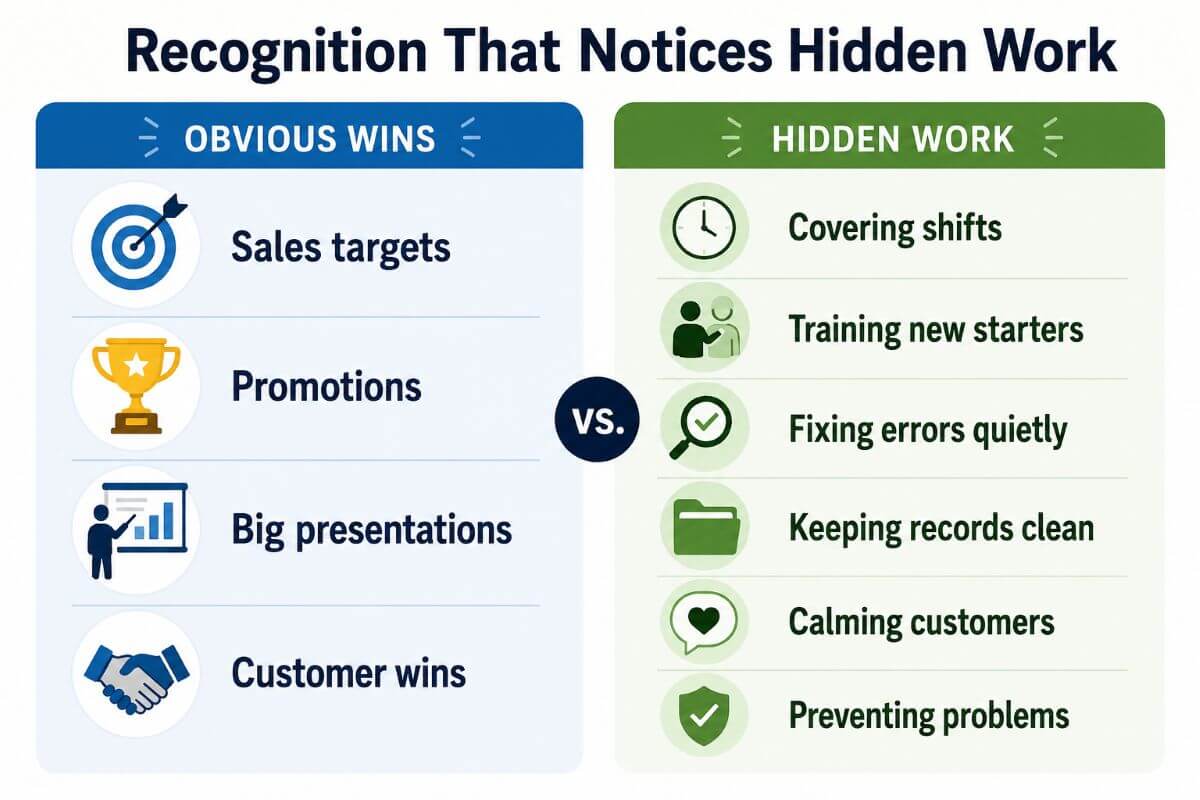
Good recognition notices the quiet work that keeps a workplace running, not just the most visible wins
Recognise hidden work, not just obvious wins
Most workplaces naturally notice visible achievements:
- Sales
- Targets
- Promotions
- Big presentations
- Customer wins
- Public problem-solving
But small employers also rely on quieter work:
- Opening up
- Closing down
- Covering shifts
- Training new starters
- Fixing errors quietly
- Calming customers
- Preparing rooms
- Keeping records clean
- Helping colleagues
- Preventing problems
If recognition only follows the loudest achievements, the people who hold the workplace together quietly may never hear that their work matters.
A useful question for managers is:
“Whose work made things easier this week, even if nobody noticed at the time?”
That question helps recognition reach the people who are often missed.
Recognise remote, part-time and shift workers too
Recognition can accidentally become office-centric.
If shout-outs only happen in Monday morning meetings, shift workers may miss them. If praise happens only in the office, remote staff may feel invisible. If awards are based on who senior managers see most often, part-time employees can be overlooked.
Simple fixes help:
| Worker type | Recognition idea |
| Remote worker | Mention their contribution in a team call and follow up with a written note |
| Shift worker | Add recognition to handover notes or the shift noticeboard |
| Part-time worker | Make sure praise is not limited to days they are absent |
| Frontline worker | Share customer compliments quickly and visibly |
| Hybrid worker | Recognise outcomes, not office presence |
| Night or weekend staff | Ask supervisors to feed recognition into the same system as weekday teams |
Fair recognition does not mean identical recognition. It means people in different working patterns still have a genuine chance of being noticed.
Make recognition fair without making it bureaucratic
You do not need a 20-page recognition policy for every thank-you. But you do need consistency.
Simple fairness rules help:
- Be clear about what is being recognised.
- Rotate attention across teams.
- Do not only recognise full-time or office-based staff.
- Include part-time, remote, hybrid, shift and frontline workers.
- Avoid recognition based only on manager favourites.
- Keep a simple note of formal awards.
- Make sure criteria do not indirectly exclude certain groups.
Acas says employers must not unfairly discriminate in any aspect of work, must take steps to prevent discrimination, and must do all they reasonably can to protect people from discrimination by others.
For recognition, that means watching patterns. If every shout-out goes to the same team, the same type of worker, or the people who are most visible to senior managers, the scheme may feel unfair even if nobody intended it to.
Fair recognition does not mean everyone gets the same praise. It means everyone has a genuine chance of being noticed for meaningful contribution.
Keep a simple record of formal awards
Informal thank-yous do not need paperwork. Formal awards should be recorded.
A simple record can include:
- Date
- Employee name
- Team
- Award or recognition type
- Reason
- Any gift or award value
- Manager or nominator
- Whether it was public or private
This helps with fairness, tax checks, repeat nominations and year-end review. It also makes it easier to see if recognition is reaching all teams or only the most visible employees.
Be careful with gifts, vouchers and tax
A verbal thank-you is usually the simplest form of recognition. Once you introduce gifts, vouchers or awards with monetary value, UK employers should be more careful.
HMRC’s trivial benefits rules say a benefit is exempt only if all the conditions apply: it costs £50 or less, is not cash or a cash voucher, is not a reward for work or performance, and is not in the employee’s contract.
That last point matters. A small gift given simply as a seasonal gesture may be treated differently from a gift given specifically as a reward for performance. Do not assume something is tax-free just because it is small.
Long-service awards have separate HMRC rules. A non-cash long-service award can be exempt if the employee has worked for the employer for at least 20 years, the award is worth less than £50 per year of service, and the employee has not received a long-service award in the previous 10 years.
For small employers, the safest approach is simple:
- Use words freely.
- Use small gestures thoughtfully.
- Check with payroll or your accountant before gifts or vouchers become routine.
- Do not describe tax-sensitive gifts casually in a way that conflicts with HMRC rules.
This is general guidance, not tax advice. For specific treatment, check HMRC guidance or speak to your payroll or accountancy adviser.
Use small awards for moments that deserve something physical
Most recognition does not need an object. Some moments do.
A small award, certificate, plaque or engraved trophy can make recognition visible. It gives the employee something to keep, display or take home. That is useful when the moment marks a milestone, team event, long service, retirement, completion, customer service achievement or company value.
| Moment | Simple award idea |
| Employee of the month | Small engraved trophy or desk award |
| Long service | Plaque or premium engraved award |
| Team milestone | Shared trophy plus individual certificates |
| Project completion | Team medals or thank-you cards |
| Customer service recognition | Certificate plus small award |
| Apprenticeship completion | Medal, certificate or glass award |
| Retirement | Personalised plaque |
| Values award | Small trophy with category engraving |
Once you know what you are recognising, choosing the right award becomes easier. The object should carry the meaning you have already created.
A generic trophy cannot fix vague recognition. But a well-chosen award can make specific recognition last.
Give managers simple wording prompts
Managers often avoid recognition because they think it needs to sound polished.
It does not. It needs to sound true.
Give managers simple prompts:
- “I noticed that you…”
- “That helped because…”
- “The impact was…”
- “What stood out was…”
- “The team benefited from…”
- “That made a difference to…”
- “Thank you for doing the part that people do not always see.”
Example:
“I noticed you stayed late to finish the handover notes. That helped the morning team start without confusion, and it saved the supervisor a lot of time. Thank you.”
Another example:
“You handled that complaint without making the customer feel dismissed. That protected the relationship and gave the rest of the team a clear example to follow.”
The wording does not need to be dramatic. In fact, it usually works better when it is plain.
Check consent before public recognition
Public recognition can be powerful, but it should not be automatic.
Before sharing someone’s name, photo, story or award publicly, check your internal policies and get the person’s agreement where appropriate. This is especially important for:
- Website posts
- LinkedIn posts
- Newsletters
- Photos from award events
- Customer stories
- Case studies
- Local press mentions
You can keep this simple:
“We’d like to mention your award in the staff newsletter and share a photo. Are you happy with that?”
If someone says no, they can still be recognised privately. The purpose is appreciation, not exposure.
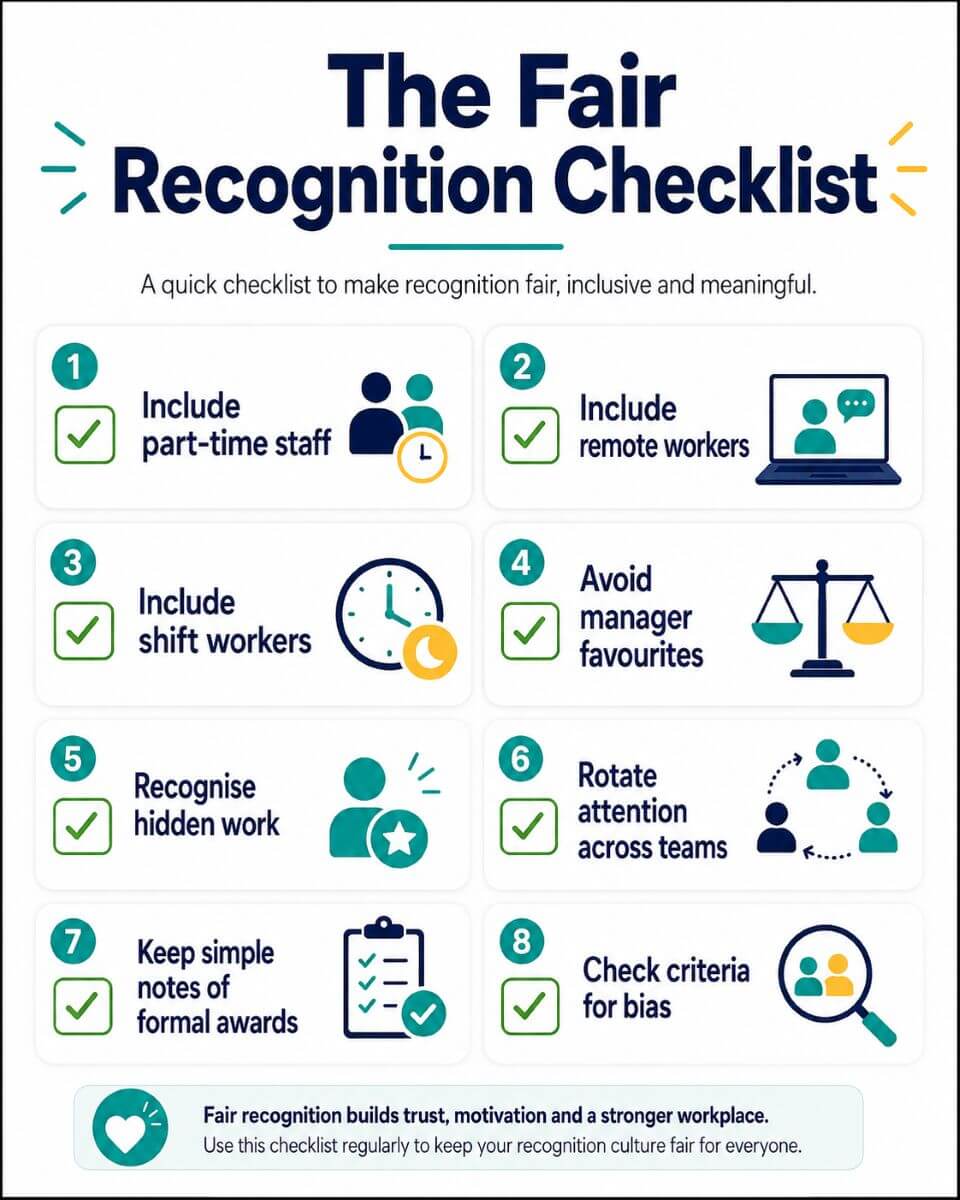
keep staff recognition fair, inclusive and meaningful. Fair recognition means making sure part-time, remote, shift and behind-the-scenes workers all have a genuine chance to be noticed
Avoid the things that make recognition feel fake
Recognition can feel hollow when it is vague, late, unfair or used to avoid bigger problems.
Common mistakes include:
- Saying “great job” with no detail
- Only recognising target-hitters
- Praising people months too late
- Giving public praise to someone who hates attention
- Misspelling names on certificates or awards
- Making every award sound the same
- Rewarding presenteeism instead of contribution
- Ignoring part-time, remote or shift workers
- Using recognition to avoid addressing pay, workload or management problems
CIPD’s evidence review notes that recognition and non-financial rewards can have positive effects on motivation and performance, but also highlights possible downsides, including envy, resentment and discomfort in some public recognition situations.
Recognition is not a substitute for fair pay, manageable workloads or respectful management. It works best when it sits on top of decent employment practice, not instead of it.
Know when recognition is not enough
Sometimes recognition is the wrong answer to the real problem.
A thank-you will not fix:
- Chronic understaffing
- Unsafe workloads
- Burnout
- Unpaid overtime
- Low pay
- Poor management
- Unresolved grievances
- Bullying or discrimination
- Lack of training
- Broken processes
In those situations, recognition may still be appreciated, but it should not be used as a substitute for action.
A good test is this:
“Are we recognising good work, or are we trying to soften the impact of a problem we should be fixing?”
If it is the second, fix the problem first.
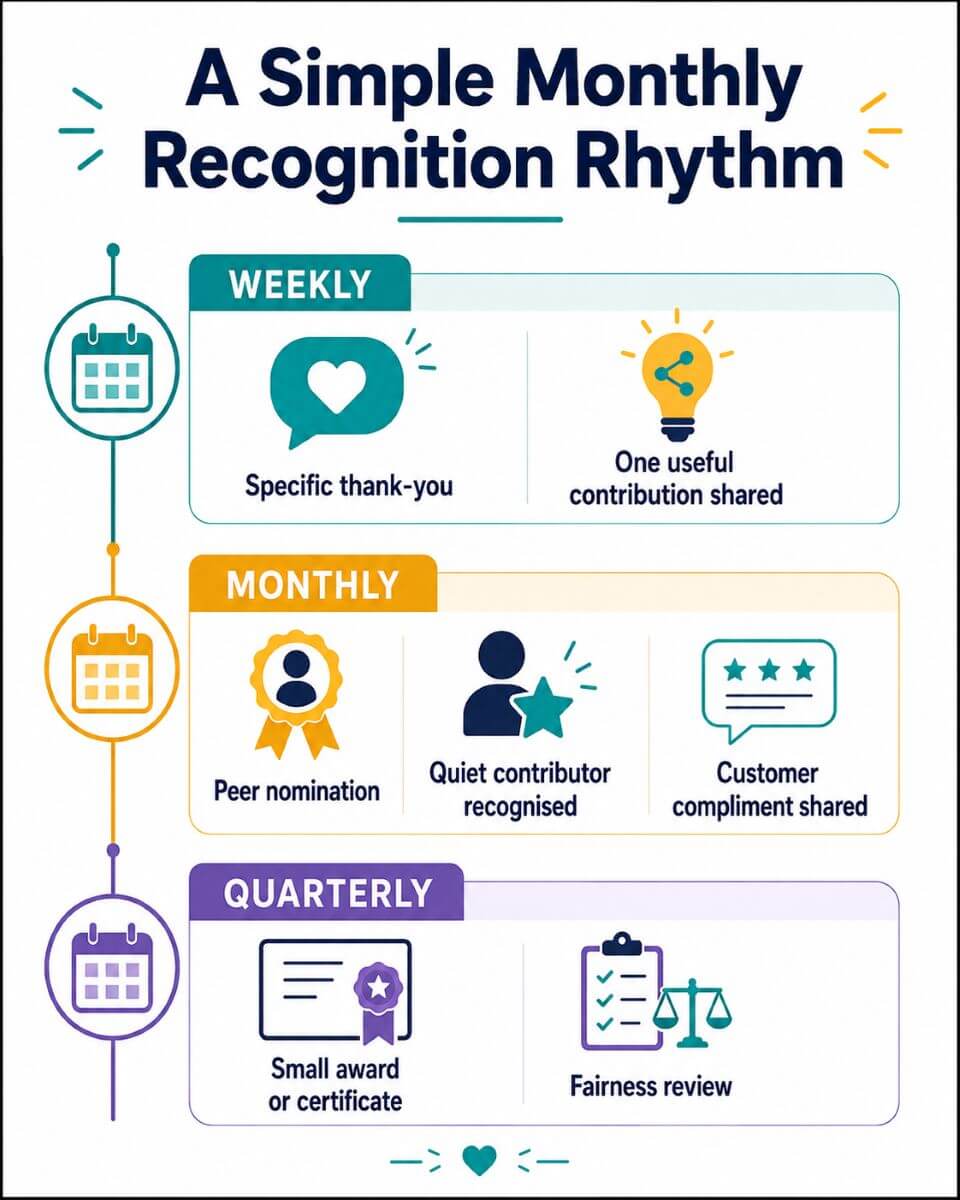
rhythm for simple employee recognition. A simple recognition rhythm helps employers make appreciation regular without building a formal rewards scheme
A simple monthly recognition rhythm
If you want recognition to happen consistently, give it a rhythm.
It does not need to be complicated.
Weekly:
– Managers give one specific thank-you.
– Teams share one useful contribution.
Monthly:
– One peer-nominated recognition moment.
– One quiet contributor recognised.
– One customer or colleague compliment shared.
Quarterly:
– Small award, certificate or team recognition.
– Review whether recognition is reaching all teams fairly.
That is enough for many small employers. The rhythm keeps recognition alive without turning it into a full reward programme.
Staff recognition checklist for small UK employers
□ Keep recognition specific
□ Recognise effort, impact and hidden work
□ Ask how people prefer to be recognised
□ Make it timely
□ Include part-time, remote, hybrid and shift workers
□ Avoid favourites and popularity contests
□ Check consent before public recognition
□ Check gift and tax rules before offering benefits
□ Use small awards for meaningful moments
□ Give managers wording prompts
□ Record formal awards simply
□ Review whether recognition feels fair
□ Do not use recognition to mask bigger workplace problems
Frequently asked questions
What is the simplest way to recognise staff?
The simplest way to recognise staff is a timely, specific thank-you that explains what the person did and why it mattered. A short note or direct message can be more meaningful than a generic award.
Do UK employers need a formal recognition scheme?
No. Small employers can recognise staff effectively through regular manager-led thank-yous, peer nominations, team meeting mentions and occasional small awards. The key is consistency and fairness.
Can employers give staff small gifts tax-free?
Sometimes, but not all small gifts are tax-free. HMRC’s trivial benefits exemption applies only when all conditions are met, including that the benefit costs £50 or less, is not cash or a cash voucher, is not contractual, and is not a reward for work or performance.
How do you recognise staff fairly?
Use simple criteria, rotate attention across teams, include part-time and remote workers, and avoid only recognising the most visible people. Employers should also make sure recognition decisions do not unfairly discriminate in any aspect of work.
What are low-cost employee recognition ideas?
Low-cost recognition ideas include handwritten notes, team shout-outs, manager emails, peer nominations, certificates, newsletter mentions, thank-you cards and occasional personalised awards.
Can recognition happen in performance reviews?
Yes. Acas says performance reviews are a chance to discuss what someone is doing well, areas for improvement, support or training needs, and development objectives. Recognition should not be limited to appraisals, but appraisals are a useful place to make good work visible.
Should employers ask how staff like to be recognised?
Yes. Some employees enjoy public praise, while others prefer private recognition. Asking people how they prefer to be recognised helps make appreciation feel more personal and less awkward.
The best recognition is simple, specific and sincere
Small employers do not need to over-engineer staff recognition.
A good thank-you, said at the right time, with the right detail, can do more than a generic reward programme. A small award, certificate or plaque can help when the moment deserves something physical. A fair rhythm keeps appreciation from depending on who happens to be noticed by the loudest manager.
The principle is simple:
Notice the work. Name the contribution. Explain the impact. Keep it fair.
That is enough to make recognition feel real.