

Clear delegation gives someone an outcome to deliver, enough authority to make progress and a dependable route to support. Passing over a task with “Can you sort this?” leaves too much open to interpretation, especially when the recipient is unfamiliar with the work.
Before delegating, check whether the task is suitable, whether the person has capacity and what you remain accountable for. Delegation should not become a way to pass an unreasonable workload or a decision you are not authorised to transfer to someone else.
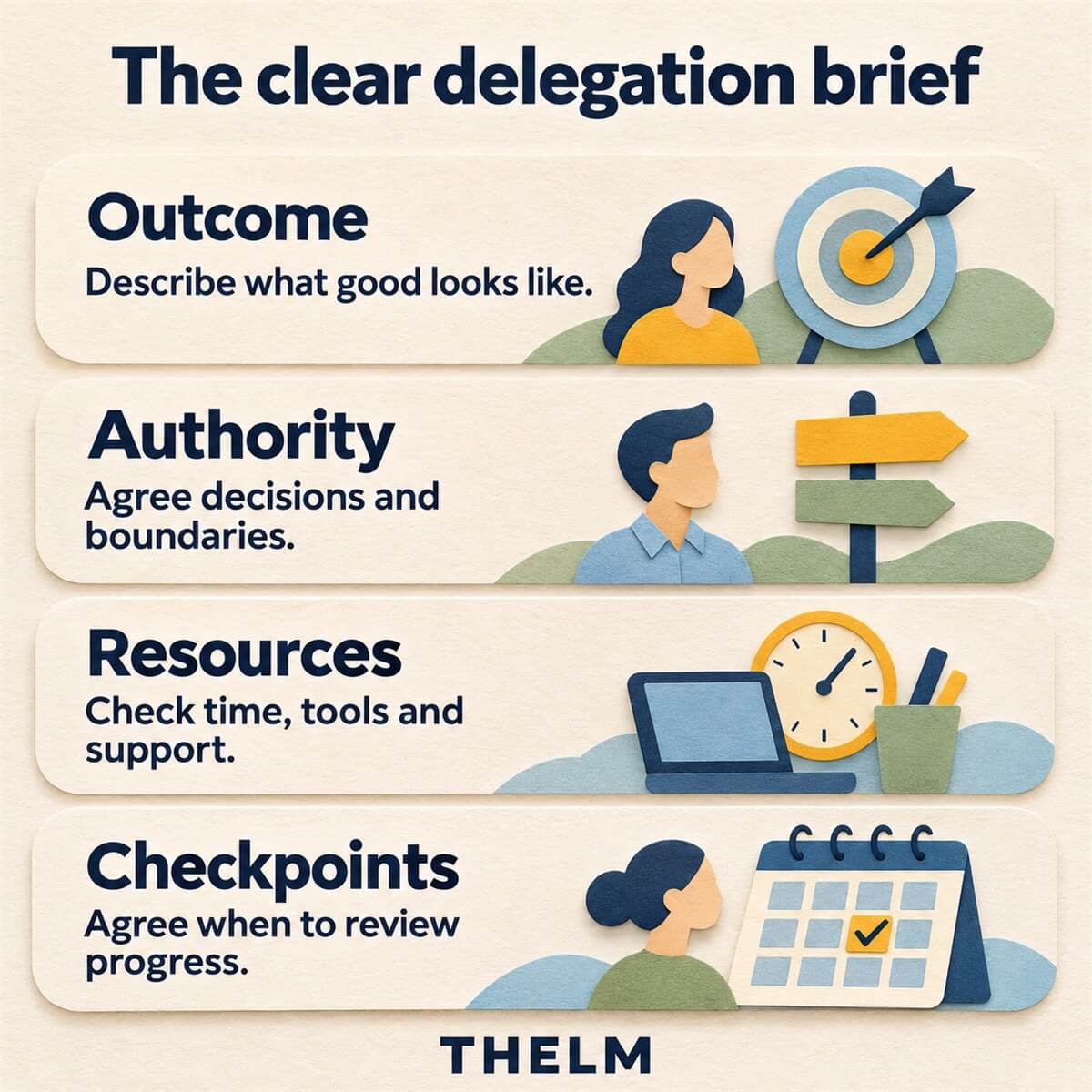
Describe the result before the method
Explain the purpose, audience and required standard. If you need a report, say which decision it will support and what information must be included. Share an example if one exists, but distinguish essential requirements from your personal formatting preferences.
Define completion in observable terms. “Update the supplier information” could mean correcting a spreadsheet or contacting every supplier. “Check these ten contact records, record the source of any change and flag entries you cannot verify” is a more usable brief.
Agree authority and constraints
Say which decisions the person can make, what they should consult you about and what needs formal approval. Include spending limits, access permissions, confidentiality requirements and dependencies. Do not assume they know the unwritten rules you have learned over several years.
Invite them to explain how they understand the task and what they need. This is a chance to discover ambiguity in your brief. It should not feel like a memory test.
A delegation brief you can copy
| Field | What to agree |
|---|---|
| Purpose | The problem or decision this work supports |
| Outcome | The deliverable and the standard it must meet |
| Authority | Decisions the owner can make and approvals needed |
| Resources | Time, tools, information and people available |
| Deadline | The due date and any earlier dependencies |
| Checkpoints | When to review progress and what to bring |
| Escalation | When and how to raise a problem |
For an illustrative example, ask a colleague to compare three venues for a team meeting. Agree the capacity, access requirements, budget and cancellation questions. Give them authority to request information, while reserving the booking decision. A shortlist with evidence is the deliverable; a completed booking is not.
Match support to the task
A person doing something for the first time may need a demonstration or an early review of their approach. An experienced colleague may only need an agreed deadline and a clear escalation route. Discuss the level of support instead of checking at random whenever you feel anxious.
Check the existing workload explicitly. If this task takes priority, identify what moves. HSE’s guidance on demands connects manageable work with available hours and capability. A deadline is not credible simply because it has been written down.
Review the result without taking the work back unnecessarily
At a checkpoint, ask what has progressed, what is uncertain and what decision would help. If the approach differs from yours but meets the agreed standard, allow room for it. If the work is off track, refer back to the brief and agree a correction.
When the task is complete, discuss what the person learned and what you could make clearer next time. Good delegation builds the team’s ability to handle future work as well as getting today’s task finished.
Related guides
- How to Set Clear Expectations Without Micromanaging
- How to Review Your Team's Workload Before Adding Another Task
- How to Share Knowledge When One Person Knows Everything
Published as part of THELM's guide library on 2 November 2026. The archive date places this guide within the series; advice and sources were reviewed on 2 November 2026.