

A staff suggestion scheme is useful when employees can raise an idea, understand how it will be considered and receive a meaningful response. A box or online form is only the collection point; the review and follow-through make the scheme worth using.
Before inviting ideas, decide who owns the process and what the organisation has capacity to consider. Asking for suggestions without a route to act on them can create avoidable frustration.
Explain the purpose and scope
Describe the kinds of improvements the scheme welcomes, such as simpler handovers, clearer information or a better customer process. Tell people what information would help reviewers understand the idea.
Keep urgent safety issues, grievances, whistleblowing and other formal concerns connected to their proper reporting routes. A suggestion form should not become a place where a serious issue waits unnoticed for the next monthly review.
Make participation practical
Offer routes that fit different jobs and working patterns. Some people may prefer a short form; others may need to explain an idea through a conversation or a simple sketch. Do not make polished writing a condition of being heard.
Explain whether suggestions can be anonymous and what that means for follow-up. If you cannot provide anonymity, say so clearly. Ask only for information needed to understand and assess the idea.
A simple suggestion form
| Prompt | What it helps establish |
|---|---|
| What problem have you noticed? | The practical issue and who it affects |
| What change do you suggest? | The proposed improvement |
| What might it help? | The expected benefit, stated as an expectation |
| What would need checking? | Costs, risks, dependencies or permissions |
| How could we try it? | A manageable test, if appropriate |
Acknowledge and assess consistently
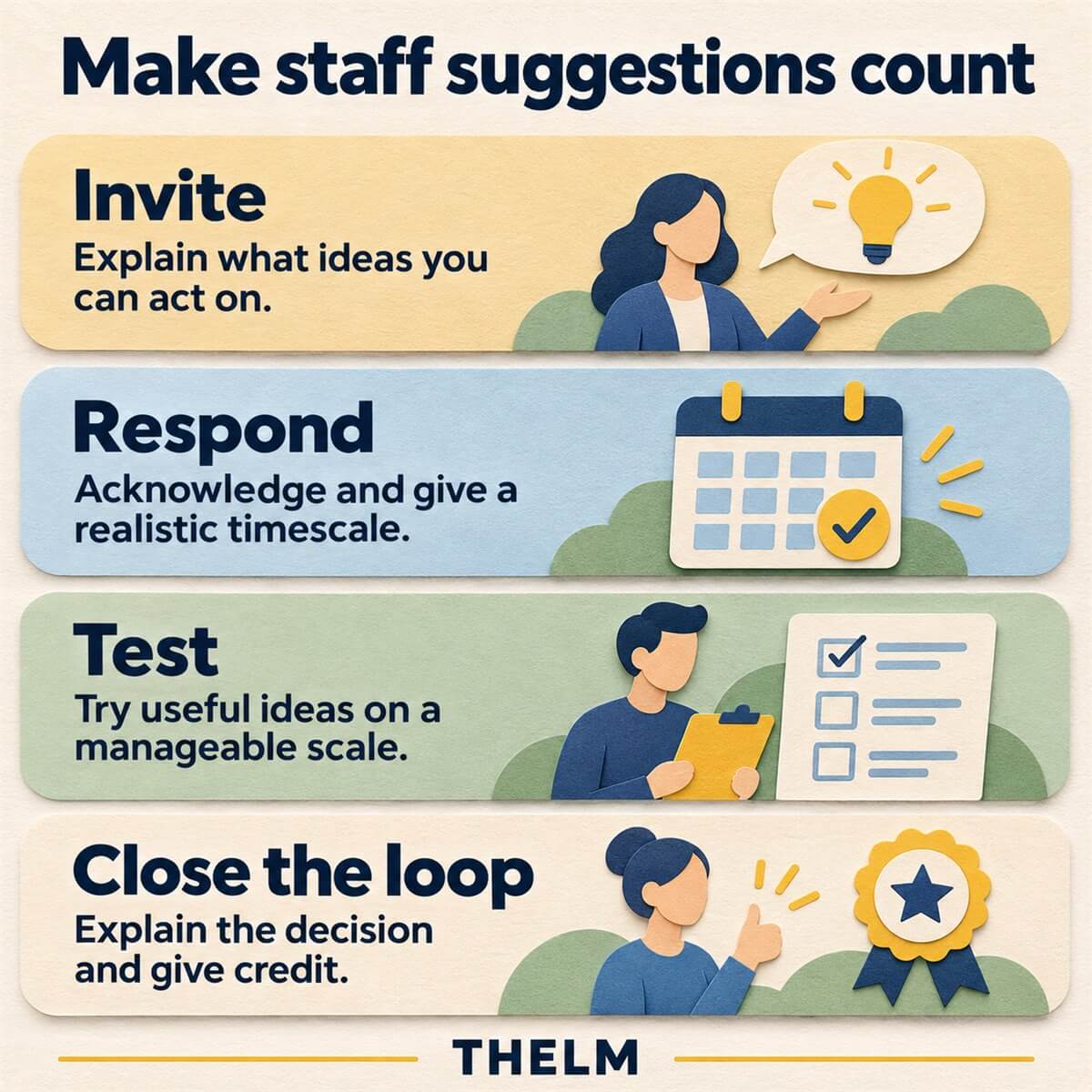
Give a realistic response timescale and name the owner. Explain the review criteria: relevance, likely benefit, practicality, risks and resources. An idea should not need a senior sponsor before it receives a fair initial look.
For a fictional example, an employee might suggest adding a short outstanding-actions section to a handover. The reviewer can check the receiving team’s needs, try it with one group and assess whether it makes information easier to use.
Test before expanding
Where a trial is suitable, agree the scope, owner, duration and what would count as useful evidence. Check necessary approvals and avoid exposing people or customers to an uncontrolled change.
Invite the person who suggested the idea to contribute if they want to and have time, but do not automatically assign them all the implementation work. A useful suggestion should not become an unexpected additional job.
Explain the decision
Tell people whether the idea will proceed, be tested, need more information or not be taken forward. Give a concrete reason. “Not now because the required system change is outside this quarter’s budget” is more informative than a generic rejection.
CIPD’s discussion of employee voice highlights the problem of inviting input without meaningful follow-up. A visible response helps employees understand that their contribution was considered, even when the decision is no.
Give credit and review the scheme
Acknowledge the original idea and the people who helped develop it, respecting preferences about publicity. Keep any formal reward criteria clear and fair.
Review response times, unresolved ideas and whether different parts of the workforce can participate. The number of suggestions alone is not a measure of success. Look at the quality of the response and whether useful changes reach the people doing the work.
Related guides
- How to Follow Up on an Employee Survey
- How to Recognise People Whose Work Often Goes Unnoticed
- How to Run a Project Debrief That Leads to Improvements
Published as part of THELM's guide library on 2 November 2026. The archive date places this guide within the series; advice and sources were reviewed on 2 November 2026.