

Your first month as a manager is a chance to understand how the team works and make your responsibilities clear. You do not need a complete transformation plan by Friday. You do need to know what the team is trying to deliver, where people need support and which decisions now sit with you.
Use the following sequence as a starting point. A team facing an immediate safety, conduct or delivery problem will need earlier action; listening does not mean leaving an urgent issue unresolved.
Start with your own brief
Meet your manager before making commitments to the team. Ask which outcomes matter, what authority you have over spending and staffing, and which decisions need approval. Clarify what you are expected to keep doing from your previous role. An invisible second job can quickly consume the time you need for management.
Write a short working brief: the team’s purpose, your responsibilities, the immediate priorities and the main constraints. Mark anything uncertain as a question. Check your understanding with your manager rather than presenting assumptions as settled policy.
Week one: listen to the people doing the work
Arrange individual conversations and make room for people on different shifts or working patterns. Ask what a normal week involves, what regularly becomes difficult and what they need you to understand. Ask what works well, too. A new manager who only collects complaints can miss the routines that keep a team functioning.
Useful questions include: “What takes longer than other people realise?”, “Where do decisions get stuck?” and “What should I avoid changing before I understand it?” Explain that you are gathering perspectives, not promising to implement every suggestion.
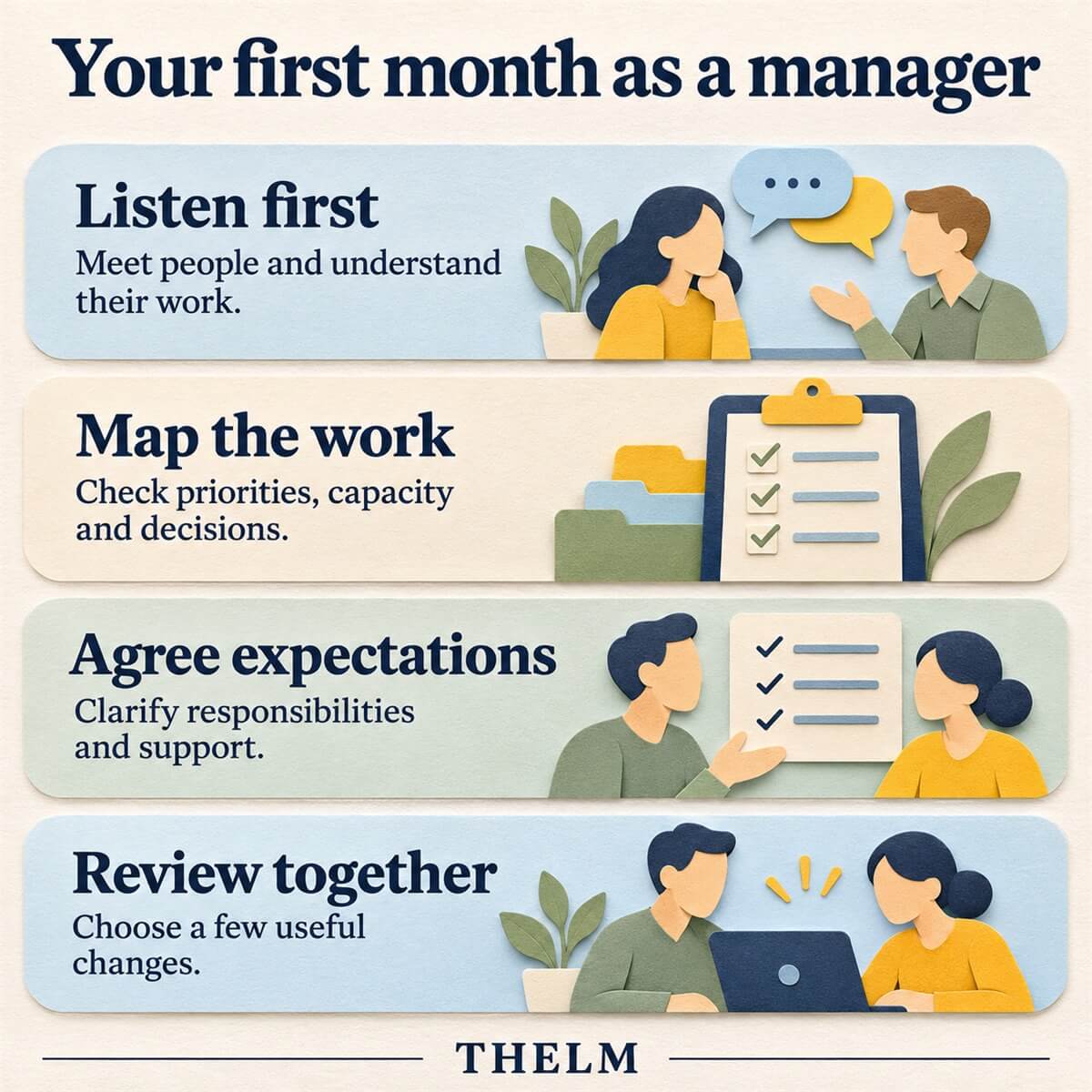
Week two: map the work and its dependencies
Review recurring tasks, deadlines, capacity and handovers. Look beyond the visible project list: customer follow-up, training, administration and helping colleagues all use time. Find out who holds critical knowledge and where another team controls progress.
For example, a fictional service team may appear slow at completing reports when the real delay is waiting for approved figures. The useful intervention is to clarify the handover, not demand faster typing. Check explanations against examples before deciding what needs to change.
Weeks three and four: agree a few priorities
Share what you have understood and invite corrections. Agree a small number of changes with a clear purpose, an owner and a review date. A predictable decision meeting or a clearer escalation route may help more than a new reporting system.
Set up regular individual check-ins. Acas includes regular feedback and one-to-ones alongside formal performance reviews. Agree how people should raise urgent concerns between meetings, and avoid treating a calendar appointment as the only opportunity to speak.
A first-month working checklist
| By when | Useful output | Check with |
|---|---|---|
| End of week one | A clear management brief and a conversation with each team member | Your manager and the team |
| End of week two | A map of priorities, recurring work and dependencies | The people doing the work |
| End of week three | Agreed responsibilities and a manageable improvement list | Owners of affected work |
| End of week four | A review of what is helping and what remains unclear | Your manager and the team |
Keep a separate promise log: what you said you would check, when you would reply and what happened. Reliability in small follow-ups gives people a concrete reason to trust your management.
Your first-month review should answer three questions: do people understand what matters, can they get the help they need, and have you acted on what you learned? Those answers provide a useful basis for the next month.
Related guides
- How to Run a Useful One-to-One Meeting
- How to Review Your Team's Workload Before Adding Another Task
- How to Set Clear Expectations Without Micromanaging
Published as part of THELM's guide library on 2 November 2026. The archive date places this guide within the series; advice and sources were reviewed on 2 November 2026.