

A useful one-to-one gives an employee and manager protected time to discuss the work, obstacles, support and development. It should leave both people clearer about what happens next. A long status report that could have been read beforehand rarely achieves that on its own.
Agree a rhythm that suits the role and the person’s needs. Someone learning a new job may need frequent short conversations; an experienced colleague may prefer more space between meetings. Review the arrangement instead of treating one frequency as universally correct.
Prepare together
Use a short shared agenda that both people can add to. Invite the employee’s topics first and add anything you need to discuss. A simple structure is enough: how things are going, progress and obstacles, feedback and development, then decisions.
Read routine updates in advance. If there is a difficult subject, explain it before the meeting so the person can prepare. Choose a private setting and allow sufficient time for the conversation you actually need. Do not place sensitive detail in a calendar invitation visible to others.
Ask questions that make it easier to explain the work
“Everything OK?” can be difficult to answer honestly. Try “Which part of this week has been hardest to make progress on?” or “Where would a decision from me help?” Ask for examples, then listen without immediately taking over the task.
Separate a need for advice from a need for a decision. A colleague may already know what to do but need authority to change a deadline. Another may want to think through options. Asking what kind of help would be useful avoids solving the wrong problem.
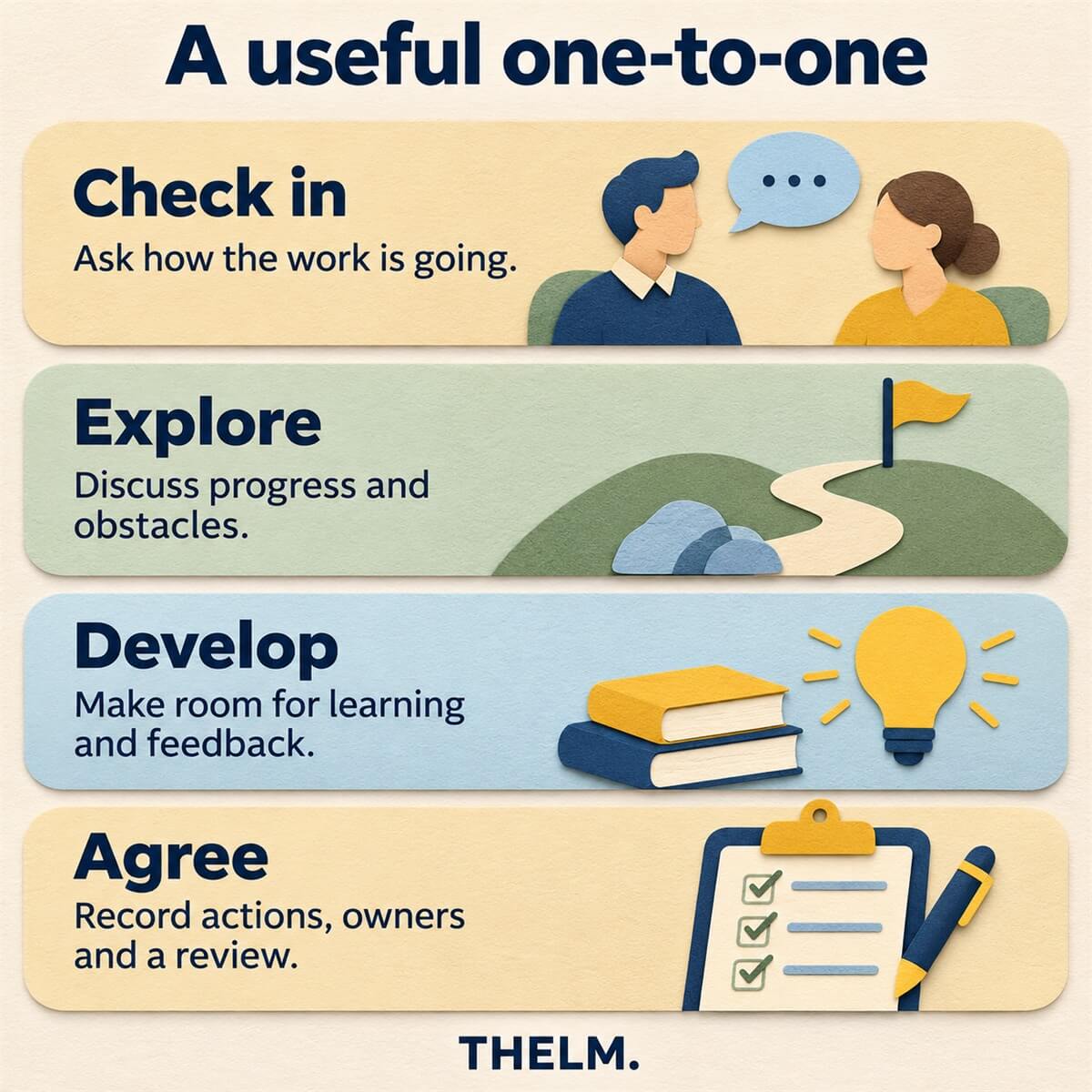
A flexible 30-minute agenda
| Time | Purpose | Example question |
|---|---|---|
| First 5 minutes | Check in and agree priorities | What would make this conversation useful today? |
| Next 10 minutes | Explore work and obstacles | What is getting in the way, and what have you tried? |
| Next 10 minutes | Discuss feedback and development | What would you like more practice or support with? |
| Final 5 minutes | Confirm decisions | What are we each doing, and by when? |
This is an illustrative allocation, not a rule. An important concern may need the whole meeting and a separate follow-up. Make that change explicitly rather than rushing a sensitive conversation to complete the agenda.
Make the manager’s actions visible
Record a few clear actions with owners and dates. “Improve communication” is vague. “Manager to confirm the handover owner with operations by Thursday” is something both people can check. Include commitments you make, not just tasks for the employee.
Keep notes proportionate, factual and secure. Agree a shared summary of work decisions and follow your organisation’s arrangements for sensitive information. Avoid copying private health or personal details into a general team tracker.
Leave room for learning and feedback
Ask what has become easier, what the person would like to learn and what you could do differently. Development does not need to mean promotion: it might involve practising a presentation, shadowing a colleague or taking responsibility for a small improvement.
Acas recommends regular informal performance conversations alongside formal reviews. Keep the purpose clear: a routine one-to-one should not unexpectedly become a formal disciplinary meeting. Use the appropriate process and support when a concern requires it.
At the next meeting, begin by checking previous commitments. If you repeatedly cancel or leave agreed actions unresolved, change the arrangement. The useful measure is whether these conversations help the employee do the work and get support.
Related guides
- How to Give Constructive Feedback
- How to Have a Career Development Conversation in a Small Business
- How to Review Your Team's Workload Before Adding Another Task
Published as part of THELM's guide library on 2 November 2026. The archive date places this guide within the series; advice and sources were reviewed on 2 November 2026.