

Managing former peers changes the relationship even when the people and workplace stay the same. You may now allocate work, handle confidential information and make decisions that affect colleagues you previously worked alongside as equals.
Acknowledge that change plainly. You can remain warm and approachable while explaining that some responsibilities and boundaries are different. Trying to pretend nothing has changed usually leaves people to guess what the new arrangement means.
Agree the transition with your own manager
Clarify your authority before discussing it with the team. Check who handles pay decisions, performance concerns, leave approval and complaints involving you. Ask your manager to explain the appointment and responsibilities to the team so you are not left announcing powers that have not been agreed.
Also agree what happens to your previous workload. Keeping all your old tasks while adding management can make you unavailable precisely when people need guidance. Identify what will transfer and who will support the handover.
Speak with each person individually
Make time for everyone, including close friends and colleagues who may have wanted the role. Ask what they need from you and what concerns they have about the change. Listen without asking them to reassure you or approve the appointment.
A useful opening is: “We have worked together for a long time, and my responsibilities have changed. I want to be clear about what that means and hear what you need from me.” Avoid promising that every decision will remain informal.
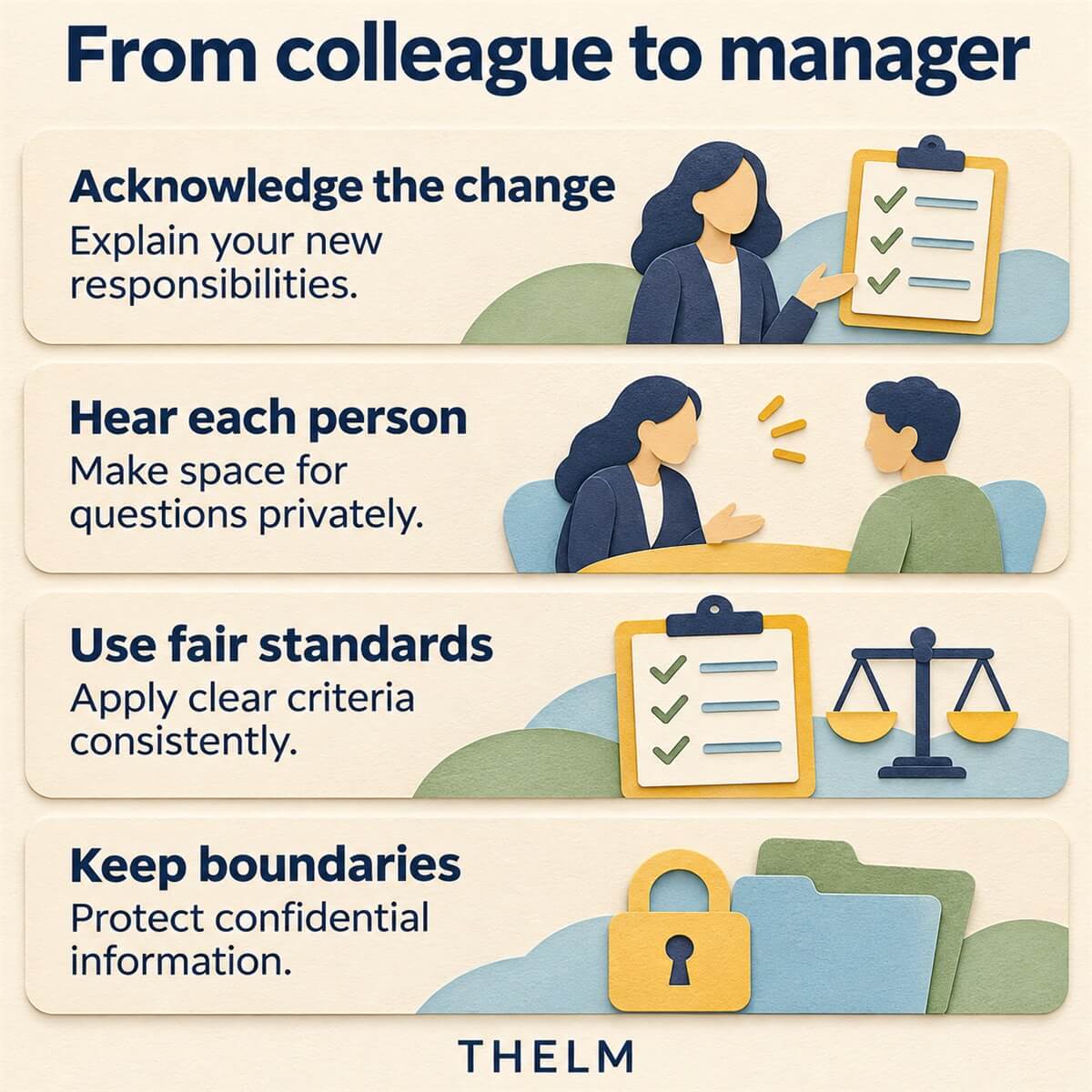
Use criteria people can understand
Make decisions about workload and opportunities using relevant criteria: skills, capacity, development needs and the requirements of the task. Explain the process wherever you can. Giving a friend the best assignment can look like favouritism; excluding them automatically to prove your independence can also be unfair.
For example, if two colleagues want to lead a client presentation, discuss the preparation required, who has suitable experience and how the other person can gain it. Record the reasoning and look at opportunities over time rather than turning one allocation into a judgement of someone’s worth.
Set practical boundaries
| Situation | A workable response |
|---|---|
| A friend asks about another employee’s review | Explain that you cannot discuss someone else’s private information. |
| A colleague expects a decision through a social chat | Bring it into the agreed work channel so it can be considered properly. |
| Someone disagrees with your decision | Hear the concern, explain the relevant reasoning and identify any review route. |
| You have a personal conflict of interest | Tell your manager and agree who should make or check the decision. |
These boundaries apply to you too. Do not use old friendships to collect private information about the team or to discuss frustrations with individual employees. Find an appropriate source of support outside the reporting relationship.
Address behaviour without reopening the appointment
If a colleague misses commitments or undermines agreed work, discuss the specific behaviour and its effect. Avoid treating every disagreement as resistance to your promotion. The person’s concern may be valid even if the conversation feels uncomfortable.
Use regular check-ins and clear expectations. Acas’s performance guidance provides a useful reference for ongoing feedback. Where a concern becomes formal, follow the organisation’s procedure and get appropriate advice.
After a few weeks, ask the team what is clear and what still feels awkward. A credible transition is built through consistent decisions and follow-through, not a single speech about being in charge.
Related guides
- How to Give Constructive Feedback
- How to Set Fair Employee Recognition Criteria
- How to Set Clear Expectations Without Micromanaging
Published as part of THELM's guide library on 2 November 2026. The archive date places this guide within the series; advice and sources were reviewed on 2 November 2026.