

Fair recognition criteria explain which contributions an organisation wants to acknowledge and what evidence supports a decision. They help employees understand the scheme before nominations open and give reviewers something more dependable than familiarity or popularity.
Start with the purpose. Recognising helpful collaboration calls for different evidence from recognising a sustained improvement to a process. Trying to reward every desirable quality through one broad “best employee” category makes comparisons difficult.
Define contributions people can describe
Use observable actions rather than personality labels. “Helped another team complete a difficult handover” is easier to evidence than “has a great attitude”. Explain the contribution’s effect and its relevance to the person’s role.
Include examples from different types of work. A receptionist resolving a recurring access problem and an analyst making a report easier to use may both demonstrate thoughtful service. The scale of the project should not automatically determine the value of the contribution.
Keep a scoring system simple
A small rubric can help reviewers organise their judgement. It cannot make a subjective decision mathematically objective. Agree the criteria and their importance before reviewing nominations, then require a short explanation for each assessment.
| Criterion | Evidence to look for | Question for reviewers |
|---|---|---|
| Contribution | A specific action or pattern of work | What did the person actually do? |
| Effect | A credible improvement or benefit | Who or what benefited, and how do we know? |
| Working approach | Relevant collaboration, care or judgement | How was the result achieved? |
| Context | Role, opportunity and available resources | Are we comparing contributions fairly? |
If you use numbers, an illustrative scale could be 0 for insufficient evidence, 1 for a relevant example and 2 for clear, well-supported evidence. Record the explanation beside the score. An absent example means the nomination may need clarification; it does not prove that the employee made no contribution.
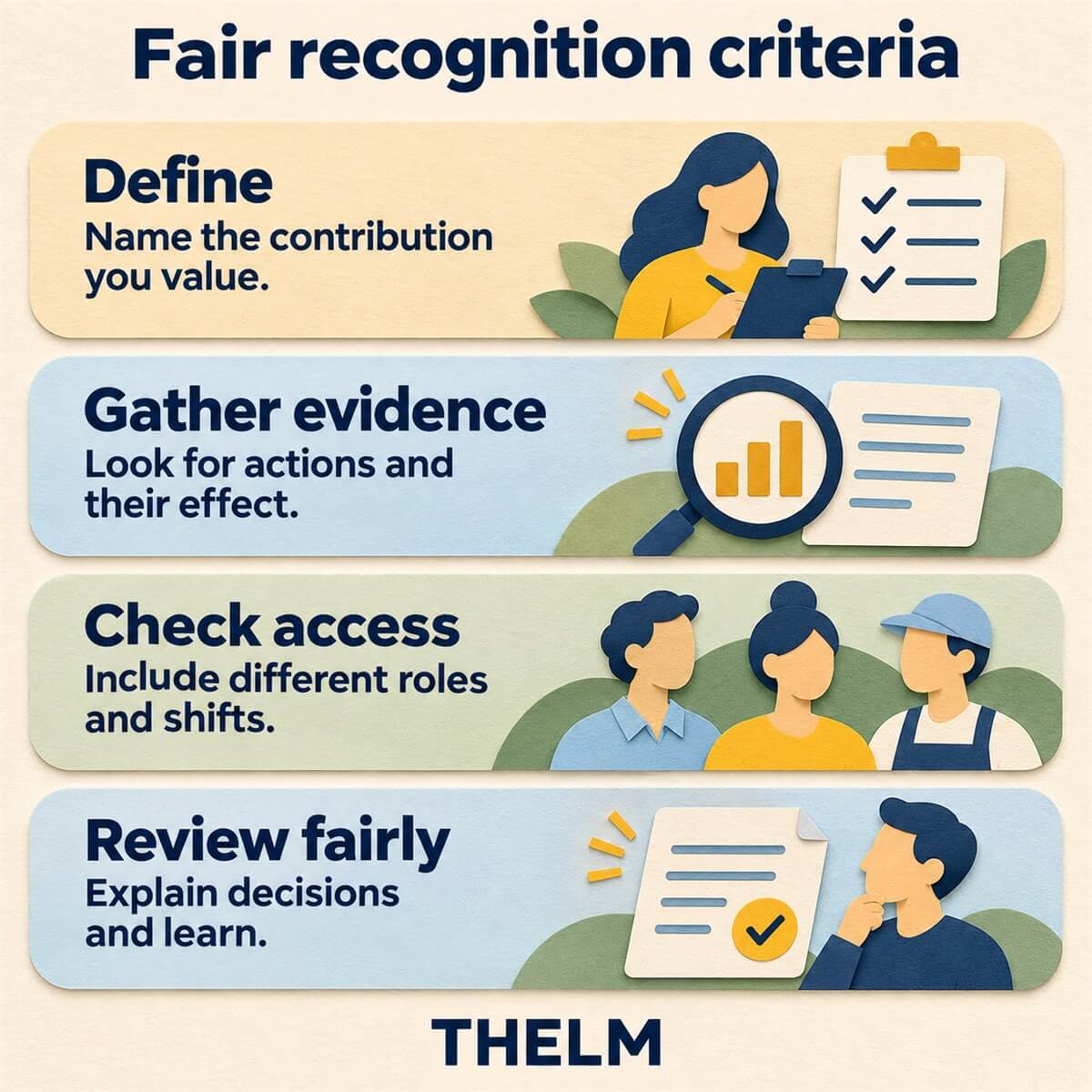
Check who can take part
Review eligibility, nomination routes and deadlines against actual working patterns. Can night-shift staff submit examples without attending a daytime meeting? Can a part-time colleague be recognised for a strong contribution within their agreed hours? Are support roles represented in the examples?
Accept concise evidence in accessible formats. A polished nomination should not outrank a useful contribution merely because the nominator writes confidently. Offer a short form with prompts and a route for someone to ask for help.
Make review decisions explainable
Use more than one perspective where practical and agree how conflicts of interest will be handled. Reviewers should not quietly change the criteria to suit a favourite candidate. Keep a proportionate record of the reasons for the decision.
The CIPD evidence review on incentives and recognition highlights fairness and the fit between rewards and the work. Use that principle to examine how the scheme operates, not just how attractive the award looks.
Review patterns after the scheme runs
Look at which roles, locations and working patterns are being recognised. Ask employees whether the reasons are understandable. Repeated gaps are a reason to investigate access and evidence, not to impose an automatic quota or assume someone has behaved unfairly.
Publish a clear explanation of the recognised contribution, with appropriate agreement from the person involved. Continue giving everyday thanks outside the scheme. A formal award should add to a culture of appreciation, not become its only expression.
Related guides
- How to Recognise People Whose Work Often Goes Unnoticed
- How to Recognise Remote, Part-Time and Shift Workers Fairly
- Employee of the Month: When It Helps and When to Rethink It
Published as part of THELM's guide library on 2 November 2026. The archive date places this guide within the series; advice and sources were reviewed on 2 November 2026.