

Repeated conflict between two team members can disrupt work and affect the people around them. A manager should take the concern seriously, understand the behaviour involved and choose an appropriate response.
Do not assume every clash is a mutual personality problem. Bullying, harassment, discrimination, threats or other serious conduct concerns may require a formal process and specialist advice. Avoid asking someone to negotiate away a serious complaint or accept an unsafe situation.
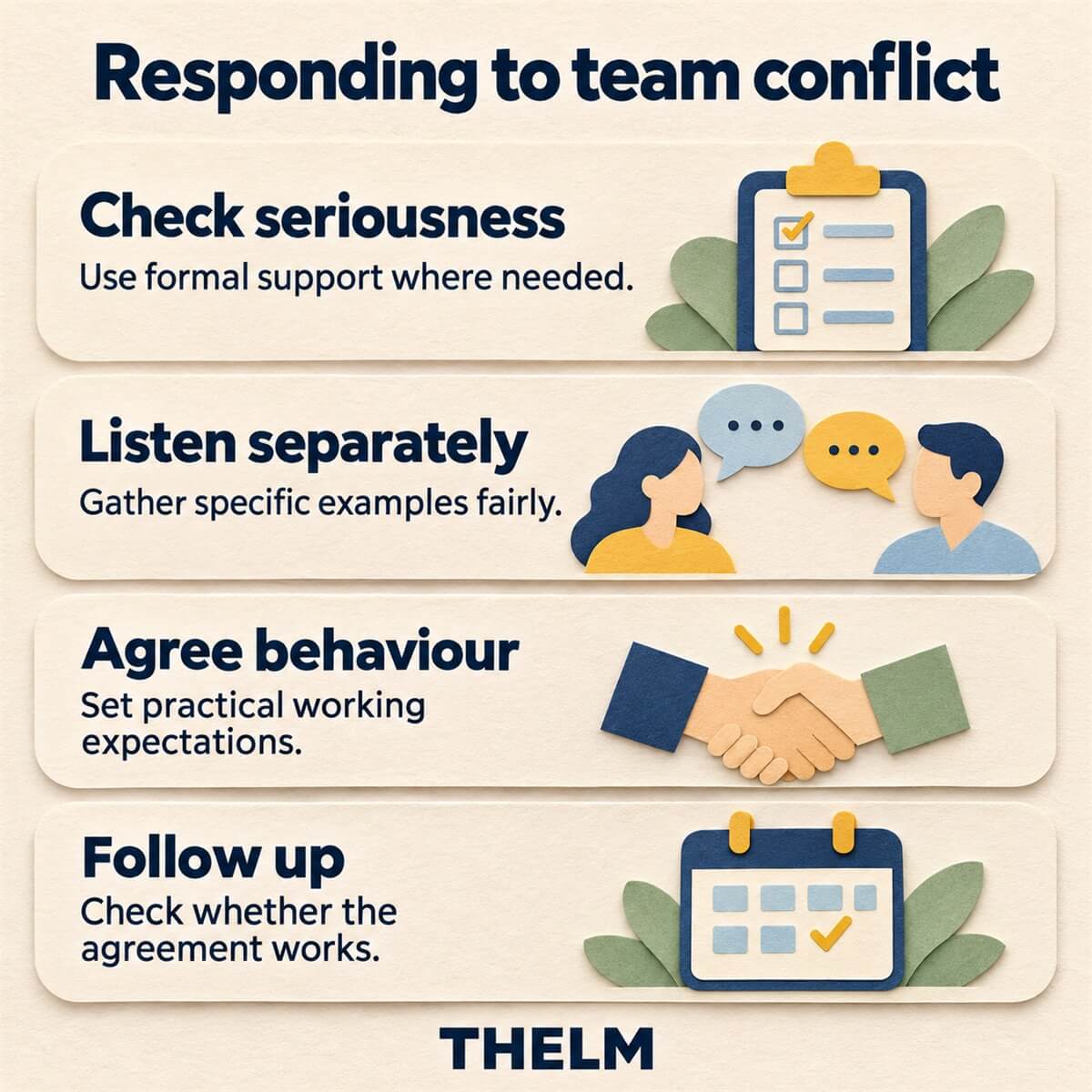
Check the nature of the concern
Ask what has happened, when, who was involved and how it affects the work. Separate specific examples from labels such as “difficult” or “negative”. Check relevant policies and whether any immediate protective action is needed.
Acas identifies circumstances where complaints need formal handling, including seriousness and the possibility of disciplinary action. Get appropriate support rather than improvising a process outside your authority.
Hear each person separately
For a concern suitable for informal discussion, speak privately with each person and listen without deciding the outcome in advance. Ask about examples, the work arrangements and what they think would help.
Explain how information will be used and the limits of confidentiality. Do not promise to keep everything secret if you may need to act on a safety or conduct concern. Keep factual notes in the appropriate secure place.
Look at the work as well as the relationship
Unclear responsibilities, competing targets and unreliable handovers can fuel repeated disagreements. Addressing those conditions may be part of the solution, even when people also need to change how they communicate.
For an illustrative example, two colleagues may argue over unfinished customer requests because neither knows who owns the final response. A shared ownership rule and an escalation route could remove a recurring source of friction.
Agree specific working behaviours
| Area | Possible agreement |
|---|---|
| Handover | Record the owner and next action before transferring work. |
| Disagreement | Raise the issue directly and respectfully through the agreed channel. |
| Decision | Use the named manager when a decision cannot be resolved within the team. |
| Review | Check the arrangement after an agreed period and report further concerns promptly. |
If a joint conversation is appropriate, discuss it with both people in advance. Explain the purpose and how it will be conducted. Do not force a surprise confrontation in a team meeting.
Consider support and follow-up
Mediation is a voluntary process involving an impartial mediator. It can help with some relationship difficulties, but it is not a universal substitute for investigation or a formal procedure.
Follow up with each person and check the effect on the work. An agreement is not complete simply because a meeting ended politely. If behaviour continues or new information changes the seriousness of the concern, reassess the response.
Keep the wider team informed about any changed work arrangements without sharing private details. The aim is a workable, respectful environment and an appropriate response to the underlying issue, not a public judgement about whose personality is to blame.
Related guides
- How to Give Constructive Feedback
- How to Run a Useful One-to-One Meeting
- How to Set Clear Expectations Without Micromanaging
Published as part of THELM's guide library on 2 November 2026. The archive date places this guide within the series; advice and sources were reviewed on 2 November 2026.