

Employees can value different forms of recognition. One person may appreciate a public mention; another may prefer a quiet thank-you or an opportunity to learn something new. Asking about those preferences helps managers choose a suitable approach.
Keep the conversation practical. You are learning how someone likes their contribution to be acknowledged, not offering an unlimited reward menu or asking them to disclose personal circumstances.
Explain what the answers will influence
Say why you are asking, who will see the responses and what is within your control. For example: “I want to make everyday recognition more useful. Your answers will help me choose how to thank you and understand anything you would prefer to avoid.”
If there is a fixed budget or a formal scheme, make that clear. A question about preferred development opportunities should not imply that a course, promotion or pay change is guaranteed.
A short preference questionnaire
- When someone notices good work, do you usually prefer private thanks, a team mention, a written note or another approach?
- Are there any forms of recognition you would rather avoid?
- Would you like me to check with you before sharing an example of your work more widely?
- What kinds of contribution do you think we currently overlook?
- Can you describe a time when recognition felt useful or meaningful to you?
- Is there anything about the current process that makes it difficult for you to take part?
Offer “it depends” and an opportunity to explain. People may enjoy a public mention for one achievement but prefer privacy for another. Avoid treating the answers as permanent personality labels.
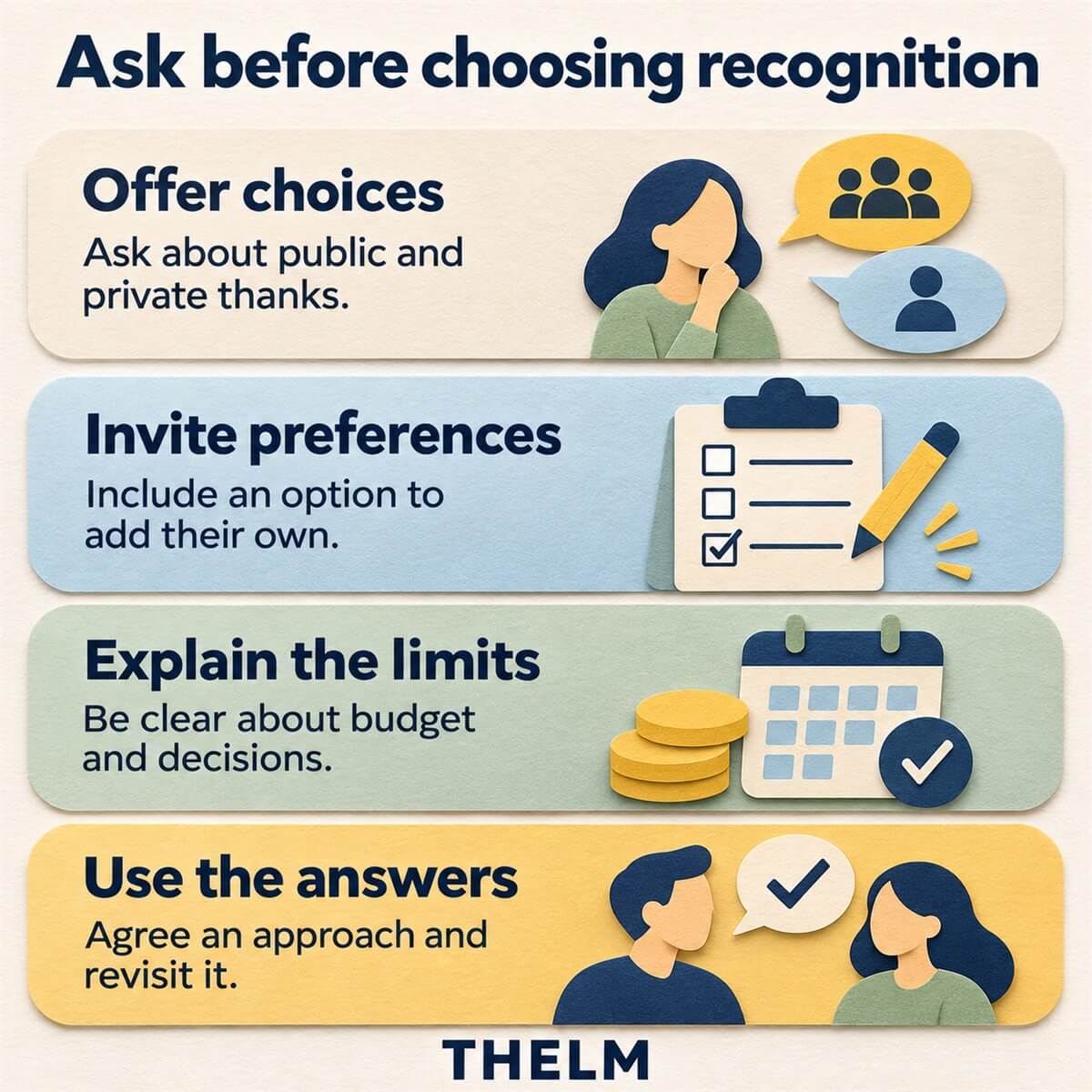
Choose a suitable way to ask
A one-to-one conversation allows follow-up questions. A brief form can give people time to think. For a wider team exercise, explain whether responses are identifiable and avoid promising anonymity if you cannot provide it.
Ask only for information you need and keep it in an appropriate place. A simple note that someone prefers private thanks is usually more useful than a detailed account of why. Let the person change their preference later.
Turn preferences into consistent practice
| What you learn | Possible response |
|---|---|
| Public praise feels uncomfortable | Offer direct thanks and check before sharing details. |
| Written feedback is useful | Send a short message describing the contribution and its effect. |
| Support work is overlooked | Add examples of that work to team reviews and recognition criteria. |
| Development matters | Discuss realistic learning opportunities separately from any promised reward. |
Preferences should shape the form of recognition, while criteria for formal rewards remain fair and clear. A person who dislikes public attention should not lose access to a scheme simply because its usual presentation is a ceremony.
Check whether your response helped
After using the approach, ask briefly whether it suited the person. You may discover that the specific explanation mattered more than the channel, or that they would prefer a different level of detail.
The NHS staff recognition framework offers a useful reference for meaningful everyday appreciation. Your own conversations provide the context for applying it to the people you manage.
Choose one routine opportunity to use what you learn, such as a project review or a regular check-in. Asking about preferences becomes worthwhile when employees can see that their answers change your behaviour.
Related guides
- Employee Thank-You Messages for Different Situations
- How to Recognise Remote, Part-Time and Shift Workers Fairly
- Employee of the Month: When It Helps and When to Rethink It
Published as part of THELM's guide library on 2 November 2026. The archive date places this guide within the series; advice and sources were reviewed on 2 November 2026.