

An employee-of-the-month scheme gives a team a regular occasion to recognise contribution. Whether it is useful depends on how the decision is made, what it celebrates and how employees experience it.
Before starting or renewing a scheme, ask what you want it to achieve. A monthly title alone does not explain which work matters or help a manager notice the full range of contributions in the team.
When a monthly scheme can be useful
It can provide a predictable prompt to gather specific examples and explain why they matter. Clear criteria, accessible nomination routes and an understandable review process make the recognition easier to trust.
The period should fit the work. If meaningful outcomes develop over several months, a monthly selection may reward the most recent visible incident. Consider recognising a sustained contribution or choosing a different review cycle.
Signs that the scheme needs attention
Listen when people cannot explain why someone was selected, when the same visible roles dominate or when managers feel obliged to invent a winner. A rotation that quietly guarantees everyone a turn can also undermine the stated criteria.
Do not assume disappointment proves a scheme is unfair. Ask about the process and evidence. Equally, do not dismiss a concern as jealousy when it identifies a real barrier to taking part.
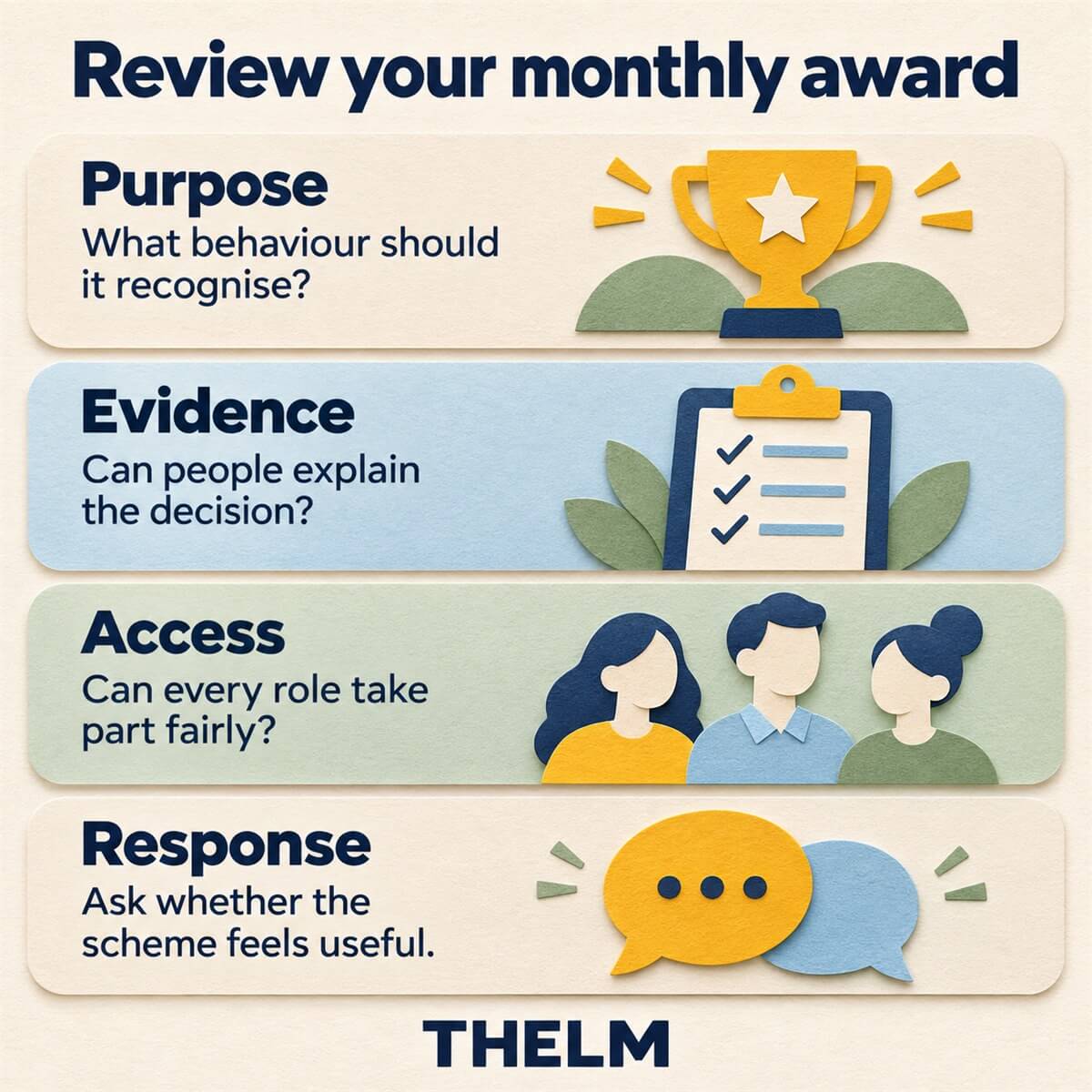
Questions for a scheme review
| Area | Useful question |
|---|---|
| Purpose | What contribution do we want people to notice? |
| Evidence | Could a reviewer explain the decision with specific examples? |
| Access | Can different roles, shifts and working patterns participate? |
| Experience | Does recognition feel meaningful to the recipient and understandable to colleagues? |
| Workload | Is the administration proportionate to the value it provides? |
Consider several ways to recognise work
A monthly scheme does not need to carry the entire recognition effort. Managers can give specific private thanks, acknowledge a team improvement, share useful customer feedback or recognise learning and collaboration.
You might replace a single winner with a small set of evidence-led examples discussed at a team meeting, with the individuals’ agreement. Another option is a quarterly review of improvements supported by regular everyday appreciation. Explain the purpose of any change and ask the team how it is working.
The CIPD evidence review emphasises the fit between recognition, the work and perceived fairness. It does not mean that one named scheme will suit every workplace.
Do not let the prize replace management
An award cannot resolve an excessive workload, unclear responsibilities or a lack of development opportunities. If the scheme repeatedly celebrates people for rescuing avoidable problems, recognise their effort and investigate the underlying conditions.
Keep any reward proportionate and check relevant payroll or tax treatment before promising gifts or benefits. This article concerns the design of recognition; an organisation’s own adviser should confirm the treatment of its particular reward.
Run a small, reviewable trial
If you introduce a scheme, define the criteria, review arrangements and feedback point in advance. Tell people how to raise a concern and who owns the process. At the review, consider participation, the quality of examples and employee feedback alongside administrative effort.
The useful question is whether the scheme helps people understand that their contribution is seen and valued. Continue, adapt or stop it on that basis, and keep everyday appreciation part of normal management.
Related guides
- How to Set Fair Employee Recognition Criteria
- How to Recognise People Whose Work Often Goes Unnoticed
- How to Ask Employees What Recognition They Actually Value
Published as part of THELM's guide library on 2 November 2026. The archive date places this guide within the series; advice and sources were reviewed on 2 November 2026.