

A useful employee thank-you message tells someone what you noticed and why it mattered. It can be brief. The detail that makes it personal is usually the contribution itself, not an elaborate adjective.
Use the examples below as starting points. Replace the situation with something that actually happened and choose wording you would be comfortable saying aloud. Do not use a message to imply a promised reward, promotion or change of responsibilities that has not been agreed.
A simple structure
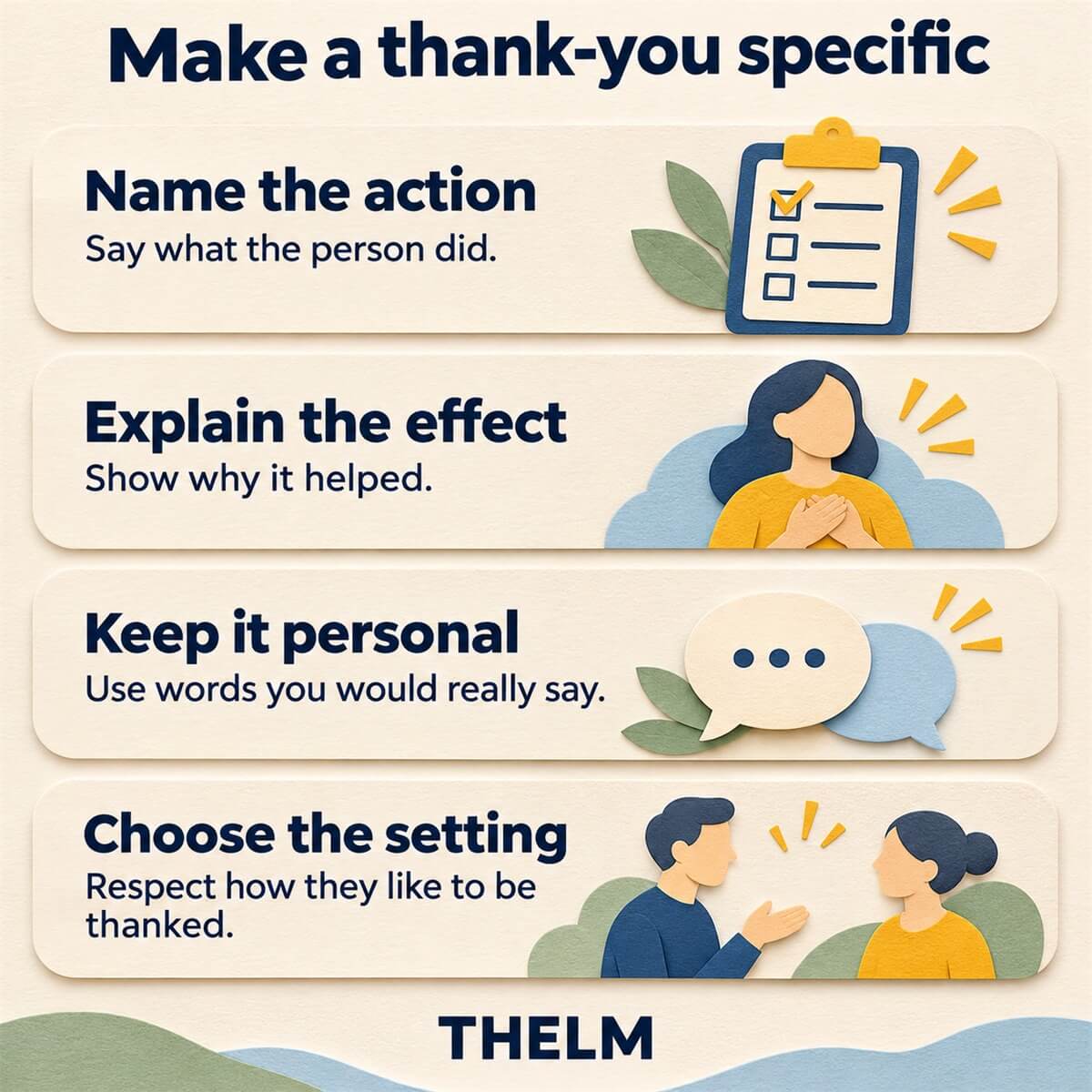
Name the action, explain its effect and offer a direct thank-you. For example: “You checked the delivery details before the order went out, which helped us correct the address in time. Thank you for taking care with that.”
Keep claims proportionate. If you know the action helped a customer understand the next step, say that. You do not need to claim it transformed the business or saved a particular amount of money.
Messages for everyday contributions
| Situation | Example wording |
|---|---|
| Helping a customer | Thank you for staying with that enquiry until the customer understood their options. Your clear explanation made the next step easier. |
| Preparing a handover | Your handover set out the outstanding tasks clearly. It helped the next shift pick up the work with confidence. Thank you. |
| Spotting an error | You noticed the mismatch and checked it before the report was sent. Thank you for being careful with the detail. |
| Supporting a colleague | Thank you for explaining the process and giving Sam time to practise it. That support helped them become more confident. |
| Improving a routine | Your revised checklist makes the checks easier to follow. Thank you for testing it with the people who use it. |
| Handling a difficult period | Thank you for keeping the team informed while priorities changed. Your clear updates helped us understand what needed attention. |
Messages for learning and progress
Recognise a specific development: “You applied the feedback from the last presentation and made the recommendation much clearer. Thank you for putting the preparation into practice.” This acknowledges the work without making a sweeping judgement about the person’s ability.
For a new starter, try: “You asked useful questions about the handover and checked your understanding before continuing. That care is helping you learn the role.” Avoid patronising language or praise that compares them unfavourably with more experienced colleagues.
Messages for shared work
When several people contributed, identify the shared result and the roles behind it. “Thank you to the scheduling and support teams for agreeing the revised plan and keeping customers informed” gives more information than “Amazing teamwork”.
If you highlight an individual within a team, explain their contribution without implying they delivered the whole result alone. Check with the project owner if you are unsure who was involved.
Choose the right setting
Ask how the person prefers to be recognised. A public message may be welcome, but it can also disclose an issue they would rather keep private. Check names, customer details and any information about personal circumstances before sending to a wider group.
For a short note to a senior manager, use: “I wanted to recognise Jordan’s work on the revised handover. They gathered the recurring questions, tested a clearer format and helped the team adopt it.” Make sure the employee is comfortable with the recognition.
Keep appreciation separate from an extra request
A thank-you followed immediately by another favour can feel transactional. Let the recognition stand on its own. If the contribution exposed a workload or resourcing problem, address that separately rather than relying on praise to make the arrangement acceptable.
The NHS recognition framework supports embedding meaningful praise in everyday interactions. A short, accurate message sent at an appropriate time is a practical way to begin.
Related guides
- How to Recognise People Whose Work Often Goes Unnoticed
- How to Ask Employees What Recognition They Actually Value
- How to Recognise Remote, Part-Time and Shift Workers Fairly
Published as part of THELM's guide library on 2 November 2026. The archive date places this guide within the series; advice and sources were reviewed on 2 November 2026.